The list · Algarve
Things to do in the Algarvewest, centre and east, with kids and in winter
The Algarve's best things to do by area: Ponta da Piedade, Sagres and the Fishermen's Trail in the west; Benagil, the Seven Hanging Valleys, Silves, Monchique and Loulé in the centre; Faro, the Ria Formosa islands and Tavira in the east. Plus kids and winter.
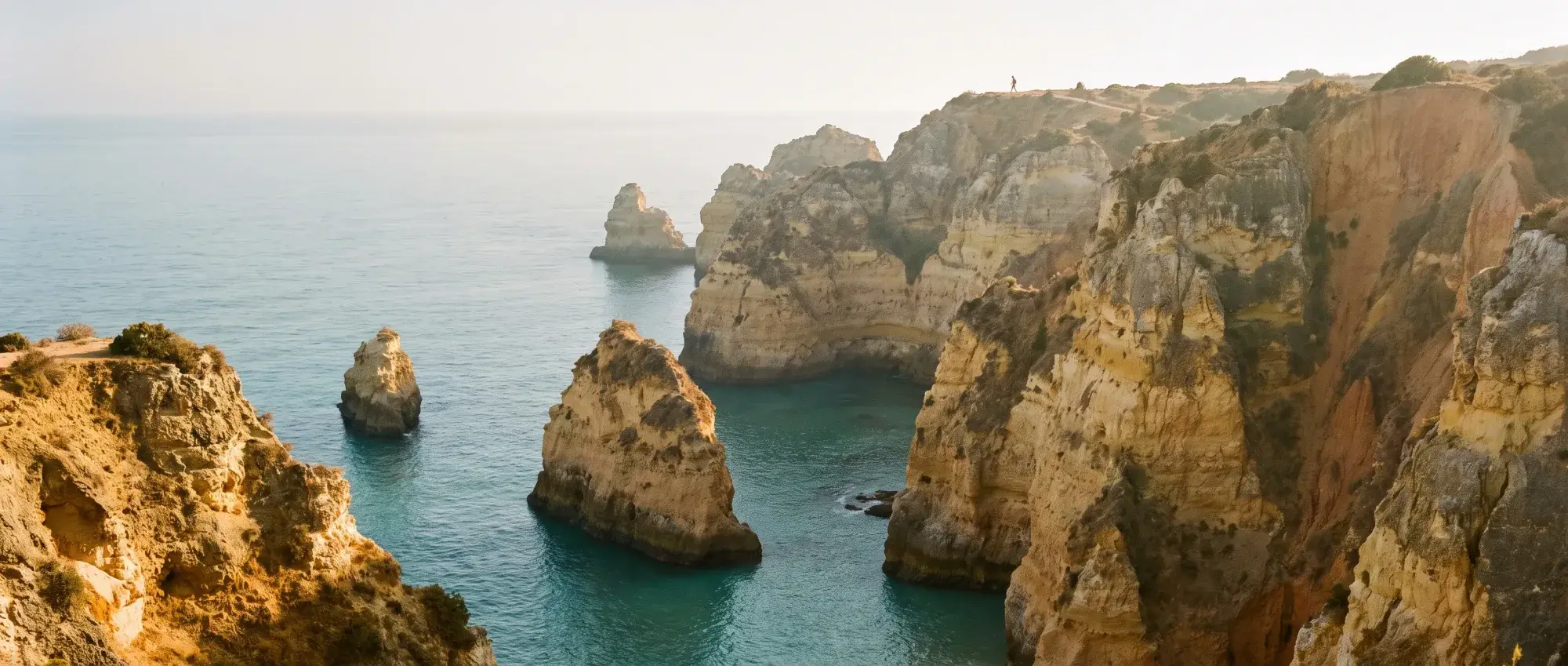
Short answer: the Algarve splits into three very different holidays. The west (Lagos, Sagres) is cliffs, grottoes and surf: take a boat into the Ponta da Piedade grottoes and stand at Cape St Vincent. The centre (Carvoeiro to Vilamoura) has Benagil, the Seven Hanging Valleys walk and the big family parks, with Silves, Loulé and Monchique inland. The east (Faro, Olhão, Tavira) is the Ria Formosa lagoon, with barrier-island beaches reached by ferry, and three old towns on the railway. Each section below links to the guide with the prices, hours and timetables.
We spent about a year in the western Algarve (Sagres, Lagos); the rest of this page is research from official sources, dated, and it says so where we haven’t been. Not sure which side suits you? Read east vs west Algarve first.
The west: Lagos, Sagres and the Atlantic coast
1. Ponta da Piedade by boat or kayak. The headland just south of Lagos is a maze of sea stacks, arches and grottoes. Local boatmen take visitors in from a landing at the foot of a long stairway below the lighthouse [1]; boat and kayak trips from the town are compared on our Lagos page. Operators, prices and the boardwalk walk to the coves are in things to do in Lagos.
2. Lagos old town and beaches. Lagos is the west’s base: a walled old town, the museum, a Saturday morning market [30] and the coves of Camilo and Dona Ana. We cover it in things to do in Lagos, Lagos beaches and day trips from Lagos.
3. Sagres fortress and Cape St Vincent. The 15th-century Fortaleza de Sagres sits on its own headland [31]; the official listing gives 09:30–17:30 [2]. About 6 km west, Cabo de São Vicente is the south-westernmost point of mainland Europe [3]. The lighthouse itself is closed to visits until further notice, according to the navy authority that runs lighthouse visits [4]. Getting there by bus is covered in Sagres without a car.
4. The west coast beaches and the Fishermen’s Trail. North of Sagres the coast turns to the Atlantic: surf beaches, few buildings, and the Rota Vicentina’s Fishermen’s Trail, a mostly sandy clifftop route its organisers recommend from September to June [5]. Our Fishermen’s Trail guide picks the stages that work as a half day, and west coast beaches sorts the beaches by surfers, beginners and children.
The centre: Benagil, Carvoeiro, Silves, Monchique, Albufeira, Loulé
5. Benagil cave, the legal way. You can no longer swim into the Benagil cave or land on its beach (since August 2024), and since July 2025 kayak and SUP trips without a guide are banned too. A licensed boat goes in for two minutes; a guided kayak or SUP group can stay up to eight [6][7]. Our Benagil cave guide compares boat, kayak and the clifftop view, with parking and advice for children.
6. The Seven Hanging Valleys trail. A clifftop path of 5.7 km one way (11.2 km there and back) from Praia de Vale Centeanes near Carvoeiro to Praia da Marinha, passing above Benagil; the municipality rates it medium and recommends spring and autumn [8]. With small children, the short Algar Seco boardwalk in Carvoeiro is the easier option. Both are in our Seven Hanging Valleys and Carvoeiro boardwalk guide.
7. Silves castle. The Castelo de Silves and the town below it are a half day, with a combined ticket for the castle and the archaeology museum [9]. Trains, the tide-dependent boat from Portimão and the August medieval fair are in our Silves day trip.
8. Monchique and Fóia. The hills behind Portimão are the Algarve’s cooler, greener side. Fóia, at 902 m, is the region’s highest point [10], and the spa hamlet of Caldas de Monchique has hot springs 6 km below the town [11]. How to get up there, by car or by bus, is in the Monchique day trip.
Also in the centre: Portimão. At the mouth of the Arade, Portimão has Praia da Rocha, a museum in its old sardine cannery, boat trips from the marina and the villages of Ferragudo and Alvor on either side; all in things to do in Portimão.
9. Albufeira. The big resort of the centre: an old town above the fishing-boat beach, the long beaches either side, the marina and Zoomarine nearby. What to do there is in things to do in Albufeira; whether to base yourself there is a separate question, answered in is Albufeira worth it?.
10. Loulé market and old town. Inland from Vilamoura, Loulé’s domed market hall opened in 1908 and was restored between 2004 and 2007 [12]; the council also lists a weekly market every Saturday [13]. The castle museum, craft workshops and walks are in things to do in Loulé.
11. Roman Vilamoura. Next to the marina at Vilamoura, Cerro da Vila is an excavated Roman site occupied from the 1st century BC to the 11th century AD, with a small museum [14]. A quiet hour away from the beach. The marina, the beaches towards Falésia and the nature trail are in things to do in Vilamoura.
The east: Faro, the Ria Formosa islands and Tavira
12. Faro old town. Faro is more than its airport. Walk through the 1812 Arco da Vila into the walled old town [15] and climb the cathedral’s bell tower, which is on the same ticket as the church and its museum [16]. The bone chapel, the market and a one-day plan are in things to do in Faro.
13. A boat to a barrier island. The Ria Formosa lagoon is lined with sandy barrier islands. From Faro, boats run to Ilha Deserta, the Farol and Culatra [17]; from Olhão, the boats to Armona and Culatra run all year, four times a day to Armona in winter [18]; from Tavira, ferries cross to the long beach of Ilha de Tavira [19]. Which island suits families, a quiet day or a car-free stay, with fares and winter timetables, is in our Ria Formosa islands guide.
14. Tavira. A low-rise river town rebuilt after the 1755 earthquake, with a bridge linking the two halves of the centre and 37 churches, among them Santa Maria do Castelo [20]. Its beach is on the island. The island ferry timetables, the castle, Barril and Cacela Velha are in things to do in Tavira; the town itself in our Tavira guide, families in Tavira with kids. At nearby Praia do Barril, a footbridge and an adapted beach train make the island reachable with a pushchair or a wheelchair [21].
15. Olhão’s markets and waterfront. Olhão, the next town east of Faro on the railway, has its market halls on the waterfront and is the port for the Armona and Culatra boats [18]. See Olhão.
With kids
The big family parks are in the centre, between Albufeira and Lagoa, and their seasons matter more than their prices.
- Zoomarine, the marine park at Guia near Albufeira, runs a reduced autumn calendar: in October 2026 it opens Tuesday to Saturday, in November only Thursday to Saturday until 28 November [22].
- Slide & Splash, the water park at Estômbar in Lagoa, closes for the season on 31 October 2026 [23].
- Aquashow in Quarteira has an indoor water park, open daily from 1 October 2026 with timed 2- or 3-hour tickets [24].
- Zoo de Lagos, inland from Lagos, opens all year (10:00–17:00 from October to March) and is reachable by town bus line 6 [25].
- Krazy World near Algoz is an interactive zoo with pools and mini golf [26]; its opening days were not readable on its site, so phone before you drive.
Ticket prices change by season and by height. We list them, read from each park’s own site, in the Algarve with kids, together with which coast suits small children, car seats, doctors and rainy days. Town by town: Lagos with kids, Portimão with kids, Sagres with kids, Tavira with kids.
In winter
Winter is mild rather than warm. Faro’s January mean daily maximum is 16.3 °C and the mean minimum 8.3 °C, with about six days of 1 mm of rain or more a month in the 1991–2020 normal [28], and the January offshore Faro sea average is 16.6 °C [32]. It is the time for walking, towns and long stays, not for beach days. More month by month in the best time to visit the Algarve.
What still works from November to March:
- Coastal walks. The Seven Hanging Valleys trail is best in spring and autumn [8], and the Fishermen’s Trail season runs from September to June [5]. Avoid windy and rainy days on the clifftops.
- Castles and old towns. Silves, Loulé, Faro and Tavira, with their market halls in the mornings and Loulé’s weekly market on Saturdays [13].
- The islands. The Olhão–Armona ferry runs all year, four times a day from October to March [18]; other island boats run reduced winter timetables or stop for the season, so check our Ria Formosa guide.
- Indoor days. The Aquashow indoor park in Quarteira [24], the Centro Ciência Viva science centre in Faro (Tuesday to Sunday, Tuesday to Saturday in January and February) [27] and the one in Lagos; details in the Algarve with kids.
- Monchique. The hills get more winter rain than the coast [11], so pick a dry day for the drive up to Fóia; see the Monchique day trip.
What closes: Slide & Splash after 31 October [23] and Zoomarine after 28 November until its next season [22], and some island boats stop for the winter while others run fewer times a day [17][18][19]. Check before you go.
Planning around it
- Itinerary: five, seven and ten-day plans that combine the west and the east are in our Algarve itinerary.
- Without a car: the trains along the coast, the bus routes, ferries and what you cannot reach are in the Algarve without a car. For Benagil, Monchique and the west coast, see Algarve car hire.
- Beaches: our Algarve beaches overview groups the beaches by coast, with lifeguard and Blue Flag status for 2026.
- Where to stay: pick the base by area: where to stay in the Algarve, or by town for Lagos, Albufeira, Vilamoura and Loulé and Tavira.
Back to the Algarve destination guide.
Sea: NOAA OISST v2.1 offshore surface temperatures, 2001–2020, calculated and checked on 11 October 2026 (Faro 36.875° N, 7.875° W [32]). We average daily values within each month and year, then give each of the 20 annual monthly means equal weight. These 0.25° grid cells are coastal proxies, not measurements at individual beaches or a forecast.
Source references
- CM Lagos: Ponta da Piedade (official beach page: lighthouse, long stairway down to the sea, local boatmen take visitors into the grottoes) · accessed
- Museus e Monumentos de Portugal: Fortaleza de Sagres (hours 09:30–17:30, last entry 17:00; closures; standard ticket €10) · accessed
- Wikipedia (en): Cape St. Vincent (south-westernmost point of Portugal and mainland Europe) · accessed
- AMN: Visitas a faróis (Farol do Cabo de São Vicente closed to visits indefinitely for operational reasons) · accessed
- Rota Vicentina: Fishermen's Trail (226.5 km in 13 stages, best September–June, mostly sand) · accessed
- AMN / Capitania do Porto de Portimão: Edital 019/2024, Benagil navigation rules (no swimming in, no landing, in force 13 Aug 2024) · accessed
- AMN / Capitania do Porto de Portimão: Edital 009/2025, amendment (2 Jul 2025): boats 2 min inside, kayak/SUP groups up to 8 min, no kayak/SUP tours or rentals without a guide · accessed
- Welcome to Lagoa (municipality): Percurso dos 7 Vales Suspensos (5.7 km one way, 11.2 km return, medium, Vale Centeanes to Praia da Marinha; best in spring and autumn) · accessed
- CM Silves: Castelo de Silves (castle and castle + archaeology museum tickets) · accessed
- Wikipedia (en): Fóia (902 m, highest mountain of the Algarve) · accessed
- Wikipedia (en): Monchique (hot sulphur springs at Caldas de Monchique, 6 km south of the town; more winter rain than the rest of the Algarve) · accessed
- Wikipédia (pt): Mercado Municipal de Loulé (opened 27 July 1908; restored 2004–2007) · accessed
- CM Loulé: Eventos tradicionais (weekly market in Loulé every Saturday; Quarteira on Wednesdays) · accessed
- Wikipédia (pt): Cerro da Vila (Roman and later site in Vilamoura, occupied 1st century BC to 11th century AD; museum) · accessed
- CM Faro: Arco da Vila (1812 gate into the old town, Monumento Nacional) · accessed
- Sé de Faro: Informações (ticket includes cathedral, museum and bell tower; seasonal hours) · accessed
- CM Faro: Horários dos barcos para as ilhas (boats from Faro to Praia de Faro, Deserta, Farol and Culatra) · accessed
- Amo-te Olhão: ferry timetables Armona, Culatra, Farol from Olhão (all year; Armona winter timetable 1 Oct–31 Mar, 4 departures from Olhão 08:30, 12:00, 15:00, 17:00; Culatra/Farol winter 21 Sep–31 May; secondary source) · accessed
- Silnido: Tavira ferries to Ilha de Tavira (town line from 7 Sep 2026, Quatro Águas line from 1 Oct 2026) · accessed
- Wikipedia (en): Tavira (rebuilt after 1755; 37 churches; Santa Maria do Castelo) · accessed
- Câmara Municipal de Tavira: Praia do Barril / Praia Acessível (footbridge, adapted beach train, ramps) · accessed
- Zoomarine: Park Calendar 2026 (October Tue–Sat 10:00–17:00; November closed 1–4, then Thu–Sat to 28 Nov) · accessed
- Slide & Splash: Opening hours 2026 (season 1 Apr–31 Oct; October 10:00–17:00, Sundays closed) · accessed
- Aquashow: Plan your visit to the indoor park (opening 1 October 2026, daily 10:00–18:00; 2 h / 3 h packs) · accessed
- Zoo de Lagos: Planeia o teu dia (1 Apr–30 Sep 10:00–19:00, 1 Oct–31 Mar 10:00–17:00; ONDA bus line 6) · accessed
- Krazy World: Planeia o teu dia (included: animal interactions, spray park, pools, mini golf; paid extras) · accessed
- Centro Ciência Viva do Algarve (Faro): homepage (March–December Tue–Sun 10:00–13:00 and 14:00–17:00, closed Mondays; January–February Tue–Sat) · accessed
- IPMA: Normal Climatológica 1991–2020, Faro (station 554), PDF (January mean max 16.3 °C, mean min 8.3 °C; rain days) · accessed
- NOAA OISST v2.1: dataset description · accessed
- CM Lagos: Feiras e mercados (Saturday market 07:00–14:00; Viv'O Mercado on Wednesdays) · accessed
- Wikipedia (pt): Fortaleza de Sagres (15th century, Infante D. Henrique; damaged 1755, rebuilt late 18th century) · accessed
- NOAA OISST v2.1 Final: daily offshore SST, faro (36.875 N, 7.875 W), 2001–2020; monthly means calculated from 20 annual monthly means · accessed
The places in this guide
| # | Place | With kids | Last checked | Map |
|---|---|---|---|---|
| 01 | Ponta da Piedade | – | 2026-10-14 | Open |
| 02 | Fortaleza de Sagres | Fine | 2026-10-14 | Open |
| 03 | Cabo de São Vicente | – | 2026-10-02 | Open |
| 04 | Praia de Benagil | Fine | 2026-10-14 | Open |
| 05 | Seven Hanging Valleys trail (Percurso dos Sete Vales Suspensos) | Fine | 2026-10-14 | Open |
| 06 | Praia da Marinha | – | 2026-10-14 | Open |
| 07 | Castelo de Silves | Fine | 2026-10-14 | Open |
| 08 | Serra de Monchique and Fóia | – | 2026-10-02 | Open |
| 09 | Mercado Municipal de Loulé | Fine | 2026-10-14 | Open |
| 10 | Cerro da Vila (Roman ruins and museum) | Fine | 2026-10-04 | Open |
| 11 | Arco da Vila and the Cidade Velha | Fine | 2026-10-14 | Open |
| 12 | Sé de Faro (Faro Cathedral) | Fine | 2026-10-14 | Open |
| 13 | Ilha Deserta (Praia da Barreta) | – | 2026-10-02 | Open |
| 14 | Ilha da Armona | Great | 2026-10-04 | Open |
| 15 | Ilha da Culatra | Fine | 2026-10-04 | Open |
| 16 | Praia da Ilha de Tavira | Fine | 2026-10-02 | Open |
| 17 | Praia do Barril | Fine | 2026-10-02 | Open |
| 18 | Zoomarine Algarve | Great | 2026-10-04 | Open |
| 19 | Slide & Splash water park | Great | 2026-10-14 | Open |
| 20 | Zoo de Lagos | Great | 2026-10-02 | Open |
| 21 | Krazy World | Great | 2026-10-14 | Open |
Further afield: Zoomarine Algarve (17 km), Mercado Municipal de Loulé (19 km), Cerro da Vila (Roman ruins and museum) (19 km), Castelo de Silves (22 km), Praia da Marinha (26 km), Praia de Benagil (27 km), Slide & Splash water park (27 km), Seven Hanging Valleys trail (Percurso dos Sete Vales Suspensos) (29 km), Arco da Vila and the Cidade Velha (35 km), Sé de Faro (Faro Cathedral) (35 km), Serra de Monchique and Fóia (36 km), Ilha Deserta (Praia da Barreta) (42 km), Ilha da Culatra (42 km), Ilha da Armona (42 km), Ponta da Piedade (46 km), Praia do Barril (50 km), Zoo de Lagos (52 km), Praia da Ilha de Tavira (53 km), Fortaleza de Sagres (72 km), Cabo de São Vicente (75 km). Straight-line distances from the centre point, not driving times.
Schematic: positions from each place's coordinates, no roads or coastline. Not for navigation.
Viewpoint
Ponta da Piedade
Headland of cliffs, arches and sea stacks south of Lagos: lighthouse, boardwalks from Canavial towards Pinhão, and a long stairway down to the boat landing (CM Lagos).
Researchedlast checked
Viewpoint
Fortaleza de Sagres
15th-century fortress on Ponta de Sagres: October–April 09:30–17:30, last entry 17:00; standard ticket €10; cliff loop walk and Rosa dos Ventos.
Researchedlast checked
Viewpoint
Cabo de São Vicente
South-westernmost point of mainland Europe, ~6 km from Sagres; 1846 lighthouse whose interior AMN lists as closed to visits indefinitely (Oct 2026); headland free to walk, parking by the road; windy.
Researchedlast checked
Beach
Praia de Benagil
Small (80 m) beach next to Benagil cave and the launch point for kayak and boat tours; lifeguards 1 Jun–30 Sep 2026, WC and restaurant, not step-free (guiadepraias.pt). Parking is the bottleneck.
Researchedlast checked
Day trip
Seven Hanging Valleys trail (Percurso dos Sete Vales Suspensos)
Clifftop walk of 5.7 km one way (11.2 km return) from Praia de Vale Centeanes to Praia da Marinha, past Benagil; medium difficulty, linear, best in spring and autumn (Lagoa municipality).
Researchedlast checked
Beach
Praia da Marinha
Limestone-cliff cove near Carvoeiro; lifeguards 1 Jun–30 Sep 2026 and “praia de uso limitado” (Portaria; CM Lagoa: rockfall risk strips at high tide); Blue Flag 2026 conflicts between sources.
Researchedlast checked
Sight€
Castelo de Silves
The red sandstone castle above Silves, open daily from 09:00; €2.80 for adults, €1.40 for children, and €3.90 with the archaeology museum (CM Silves, 4 Oct 2026; research).
Researchedlast checked
Day trip
Serra de Monchique and Fóia
Highest point of the Algarve (902 m) above the spa town of Monchique, 54 km / 55 min from Lagos by road (routing model); Caldas de Monchique hot springs 6 km south of the town (research).
Researchedlast checked
Market
Mercado Municipal de Loulé
Loulé's domed market hall opened on 27 June 1908. The operator lists Mon 07:00–15:00 and Tue–Sat 07:00–19:00; the outdoor Saturday market occupies adjacent streets (research).
Researchedlast checked
Sight€
Cerro da Vila (Roman ruins and museum)
Roman villa site and small museum five minutes' walk from Vilamoura marina, occupied from the 1st century BC; free for under-14s, €4 adults (operator; research).
Researchedlast checked
Sight
Arco da Vila and the Cidade Velha
Neoclassical gate (inaugurated 1812, Monumento Nacional) into Faro's walled old town; free to walk through, with a small interpretation centre inside the arch (research).
Researchedlast checked
Sight
Sé de Faro (Faro Cathedral)
Faro's cathedral on the Largo da Sé; one €5 ticket (official site, Oct 2026) covers the church, museum, bone chapel and bell-tower climb with views over the Ria Formosa (research).
Researchedlast checked
Beach
Ilha Deserta (Praia da Barreta)
Uninhabited Ria Formosa barrier island, boat only from Faro (CM Faro); Praia da Barreta: Blue Flag 2026 (ABAE), lifeguards 1 Jun–30 Sep 2026 (Portaria); one restaurant, boardwalk, naturist zone (CM).
Researchedlast checked
Beach
Ilha da Armona
Olhão's nearest island beach: a 15–20 minute ferry all year, a calm lagoon beach by the pier and an ocean beach about 1.7 km across the island; lifeguards on both in season (research).
Researchedlast checked
Day trip
Ilha da Culatra
Car-free barrier island south of Olhão with three settlements (Culatra, Hangares, Farol); year-round public ferry from Olhão, Faro boats in summer and into October (research).
Researchedlast checked
Beach
Praia da Ilha de Tavira
The town’s island beach: ferry from the town pier or Quatro Águas (Silnido, adult return €2.70 / €2.00, Oct 2026); Blue Flag 2026 (ABAE); lifeguards 1 Jun–30 Sep 2026 (Portaria 204-A/2026).
Researchedlast checked
Beach
Praia do Barril
Mid-island beach reached by a footbridge and a 1 km beach train from Pedras d’El Rei; Blue Flag 2026 (ABAE), lifeguards 1 Jun–30 Sep 2026 (Portaria 204-A/2026), Praia Acessível (APA 2024 list).
Researchedlast checked
Activity€€€
Zoomarine Algarve
The Algarve's marine theme park at Guia, 10 km from Albufeira by the park's own figure; October 2026 Tue–Sat 10:00–17:00, November only Thu–Sat — check the calendar first (research).
Researchedlast checked
Day trip€€
Slide & Splash water park
Water park near Estômbar (Lagoa), 26 km from Lagos (routing model); 2026 season 1 Apr–31 Oct, adult gate €32/€35, junior €24/€27, under 1 m free (research).
Researchedlast checked
Day trip
Zoo de Lagos
Zoo in Barão de São João, 13.5 km from Lagos (routing model): 170+ species, open daily 10:00–19:00 Apr–Sep and 10:00–17:00 Oct–Mar; 2026 online tickets adult €17, child 3–11 €12.01 (research).
Researchedlast checked
Activity€€
Krazy World
Interactive zoo and family park near Algoz: online tickets listed at €16.95 adult, €10.75 child (4–10), €41.95 family (2+1); the operator publishes a dated opening calendar (research).
Researchedlast checked
Quick answers
What is the Algarve best known for?
Its coast: the cliffs, arches and grottoes around Lagos (Ponta da Piedade) and between Carvoeiro and Benagil in the west and centre, the windswept capes of Sagres, and the lagoon and barrier-island beaches of the Ria Formosa in the east. Inland there are castle towns such as Silves and Loulé and the Monchique hills, with Fóia at 902 m the highest point in the region.
Can you swim into the Benagil cave?
No. Since August 2024 swimming into the cave and landing on its beach are banned, and since July 2025 kayak and SUP tours or rentals without a guide are too. You can see it from a licensed boat (two minutes inside), with a guided kayak or SUP group (up to eight minutes), or from the clifftop above (Capitania do Porto de Portimão, Editais 019/2024 and 009/2025).
Is the Algarve worth visiting in winter?
For walks, towns and a long stay, yes; for swimming, not really. Faro's January average is 16.3 °C by day and 8.3 °C at night, with about six rain days a month (IPMA 1991–2020 normal), while the January offshore Faro sea average is 16.6 °C (NOAA OISST, 2001–2020). Water parks close at the end of October and Zoomarine opens only a few days a week in autumn, but castles, markets, the Ria Formosa ferries, an indoor water park in Quarteira and the science centres keep going.
Which part of the Algarve is best for things to do without a car?
The railway towns: Lagos in the west, Faro, Olhão and Tavira in the east, where the old towns, boat trips and island ferries start within walking distance. Benagil, the Seven Hanging Valleys, Monchique's Fóia and the west coast beaches are much easier by car. Our Algarve without a car guide has the trains and buses.